Saturday, January 19, 2013

Rethinking SWTOR, TSW Relaunches

I've been spending a fair chunk of my time on two of the more prominent MMO's that underperformed in 2012 - SWTOR and TSW - of late.  Both had to redo their business models within the first year of launch, and both revisions left me in some ways scratching my head.

Given more time, experience in the games after their relaunches, and the limited detail the respective games have released, I have new theories about both games... neither of which would be good news for me as a customer of both products.  I get the impression that SWTOR is heavily dependent on its cosmetic item gambling packs and that TSW appears to be running a fire sale to keep the lights on for a few more months before going under.

SWTOR - Funded by Gambling For Items?
As someone who prefers to pay for MMO's on a non-subscription basis, I've had a hard time wrapping my head around SWTOR's new approach.  Almost everything I would have been willing to pay for was either given away for free or else has not been offered for non-subscribers to purchase at all.  I get the desire to sell subscriptions, but how do you make more money by expanding the audience if you're seemingly so opposed to actually making money from the new non-subscription players?

I'm now increasingly thinking that the goal of Free to Play had remarkably little to do with expanding the player base.  Rather, it appears to have been about creating a justification for an aggressive cash shop aimed at the previous subscribers, with gambling for items as its centerpiece.

Bioware reps are currently on an offensive to defend the Cartel packs, telling both the TORWars fansite and the game's official forums that revenue from the packs is funding the rest of development.  They put their money where their mouths are, releasing a second random cartel pack with different random items within around a month after the F2P relaunch, with two more packs already finished and more in the pipeline.

We don't have the real numbers, but the claim makes some sense.  One of the last pieces of content before the incident at Darth Hater was a poll answered by 2,500 readers of the site - overwhelmingly subscribers - said that Cartel Packs and cosmetic armor were the two most popular purchases.  Players who read a third party news site are inherently going to be the most devoted players and not necessarily representative of the average player, but the numbers are intriguing.  From the survey, 24% claimed to have spent over $50 in real money on Cartel Coins, and 12% claimed to have bought 20+ Cartel Packs (which very likely cost over $50).

This is not a random sample, but it does show that there are at least hundreds of players willing to pay $50+ in a single month on top of their subscriptions, and half of this particular sample was spending that money on Cartel Packs.  There's certainly money to be made from the cosmetic stuff - which is priced aggressively - but the random packs have to be a bigger bang for Bioware's buck when it comes to revenue per item sold.  This is a model that would never be tolerated in a subscription game cash store, but F2P may be just the excuse Bioware needed to get both their subscription fees and the most aggressive monetization normally reserved for non-subscription titles.

(Aside: Curse has posted its side of the Darth Hater saga, stating that they took over the site with the new year, and that the entire founding staff departed voluntarily without saying goodbye.)

The Secret Fire Sale?
In the month since removing the TSW's subscription fee, Funcom has announced that they sold 70,000 copies of the game, representing a 30% increase.  They then held more layoffs.  When you look at the numbers in context, you can see why they celebrated the success in this fashion.

According to numbers Unsubject dug up, Funcom was counting on 280,000 longterm sustained subscribers.  Instead, they did not even sell that many boxes - if 70K was 30% of sales as of mid-December then their total sales base at the time was roughly 230K and their current total sits somewhere around 300K.  This would indicate only marginal progress since the 200K copies sold number Unsub found at the end of the launch quarter, when he noted that the financials said the studio had not been profitable since 2010.

The stated business model for TSW right now is that some people are going to continue with the optional subscription, and the rest will pay $5-10 for DLC content as it is released.  This model does not make any sense.  Out of that 300K copies sold:

  • Some have left for good, subscription or not.  
  • Another large portion - 70K new players and probably a fair number of less dedicated existing customers - are bumming around Kingsmouth and are months away from ever spending money on endgame DLC content.  
  • Amongst the previous subscribers, some folks will not care about the optional perks on the now-optional subscription and will drop down to paying a smaller amount for DLC only when it is released instead of paying a subscription every single month.
  • There is also the brave handful who opted for lifetime subscriptions - which Funcom appreciated at the time, but who aren't worth that much more income going forward.
  • The only new revenue here are new players who pay for stuff and previous subscribers who continue to subscribe but also choose to pay extra for DLC, rather than using the point stipend included in their subscriptions.

With all of the layoffs, it is unclear how this studio is going to manage frequent content updates that people are willing to pay for - a crucial point because now they only get paid when they release new content.  Even assuming that they manage it, I'm just not seeing a source for an increase in sustained revenue.  This game already had a cash shop, and now may stand to make less money from its content depending on what current subscribers do when their time runs out.

Given the unfortunate financials, one conclusion jumps out from this data.  Funcom just sold 70,000 of what are effectively $30 lifetime subscriptions to the launch game because they need the money right now to keep the studio open.  If I'm right, they're mortgaging their future income because otherwise they have no future.

To be clear, I'm not writing this because I hate the game or want it to fail.  I'm actually enjoying myself.  And I'm putting my time where my analysis is by getting as much as I can out of the game right now, because I'm unfortunately not optimistic that this product will be around to play if I wait six months.

Thursday, January 17, 2013

Power Escalation In TSW

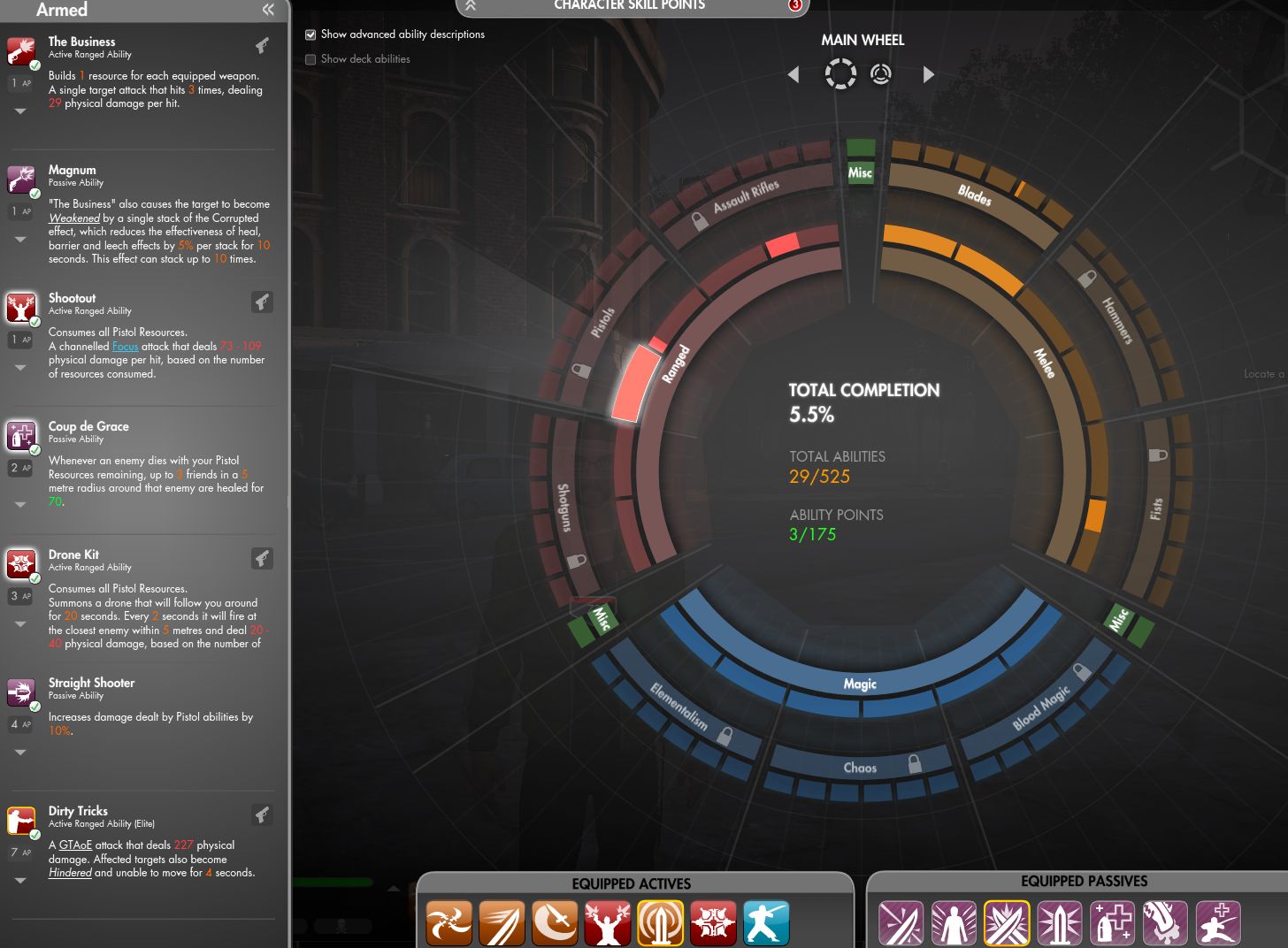
I'm currently about halfway through the Savage Coast zone in TSW, and I've had a bit more time to play around with the game's skill system.  One of the things that I find very interesting is how the developers try to expand your skill options as you gain more ability points without blowing the power curve out of the water. 

A key part of this plan is that higher end abilities tend not to do more damage/healing/etc.  Rather, they offer different and often more advanced secondary effects which might eventually add up to better performance if combined appropriately.  For example, sword-based finishers: 
  • Balanced Blade, the basic AOE attack that everyone gets to start with, does AOE damage around the player and then gives back some sword resources if any targets were impaired (a debuff that happens less frequently because it also blocks actions by the victim)
  • Five Petal Lotus, a mid-range ability does the same damage, but can center the attack anywhere the target happens to be, rather than just on the player
  • Clearing the Path (CTS), a few steps further down the tree, still does the same damage but also always counts as an armor-penetrating hit against targets that are afflicted with damage over time
CTS is more powerful in that you can combine it with one set of abilities that make all your enemies afflicted, and then use your passive skill slots to load up on benefits that trigger when you penetrate armor.  All the secondary effects do a lot for your survivability, and even some additional damage.  All of this is incidental to doing the same damage as your base entry level skill.

No Respecs - good or bad?
One other point that seems to annoy some players is the lack of a respec option.  There is no limit on how many ability points you can get (well, until you run out of abilities to buy), and there is no increase in the amount of exp required to get ability points.  (The high end abilities do cost more ability points, but higher difficulty content awards more exp.)  As a result, the claim is that there is no need to refund spent points, because you will always have that the abilities you unlocked available as future options (including passive abilities, some of which are beneficial even if you do not use the weapon you got them from). 

I was a player who would completely switch soul builds in Rift every few levels just to see what I could do with more soul points.  As such, this system does not bother me much - I'm more than halfway through unlocking all the basic "inner wheel" abilities for all of the weapons (even the ones I'm not using often), changing out my weapons as I go (I've stuck to blade and experimented with pistols, fist, blood, and now rifles).  Because of the relatively flat power curve, I don't think I'm suffering too badly from this - someone who power-burned straight to an optimal cookie cutter build may be objectively more powerful, and I do occasionally hit a wall (usually prompting a build swap) but in general I'm not having problems.

That said, I can also see how someone who picked a single pairing early and did not spend any points outside those two choices could end up frustrated at mid levels with no way to jump ship on a build that is no longer cutting it.  If you just straight up swap into two weapons you have never used before, you'd in principle have to go all the way back to newbie land to start repeating content - though it's probably faster to take a step down in difficulty and bank up enough points using your existing gear to get started with your new combo.  Then again, if you really dislike your current build that could get frustrating, especially if you are similarly disappointed with your second attempt.

Overall, I don't think it's a bad system because it offers an incentive - but not a requirement - to try different things (you can always buy abilities for weapons you never intend to use if you need a specific passive ability).  Increased options are a fun reward that is probably worth the price to me personally... but then I guess I like the system to begin with.  

Monday, January 14, 2013

The Cost of Per-Hero Games

The Marvel Heroes "free to play MMO Action-RPG" is rolling out pre-launch prepurchase offers that include a $200 "Ultimate Pack" for access to all heroes and costumes announced for launch.  Traditional MMO's with a premium package this expensive have typically had to throw in a lifetime subscription. In the case of Marvel, the pack is very clear that it does not get you anything beyond the heroes announced for launch (some of which have since been delayed but will be included in the pack when they are completed).  Instead, they are marketing the $200 as a discounted price - "a $750 value" compared to what it would cost to buy the characters individually.

The sub-$10 character
Looking at Marvel Heroes' cheaper pre-launch packs, individual heroes are bundled with some costumes and exp potions for $20, but my guess is that you will be able to get your characters for less than the psychologically significant $10 price point to encourage impulse purchases post-launch.  There seems to be broad consensus around this type of price point across a variety of other games in a variety of genres.  A few examples:
  • Champions in the MOBA League of Legends
  • Mechs in the mech-based FPS Mechwarrior Online
  • Heroes in the Warhammer Online Spin-off MOBA Wrath of Heroes
  • Most monster player classes in LOTRO (free to those who take the optional subscription)
  • Premade PVP "legends" characters in DCUO
  • The $9 action figures that grant access to DLC characters in the popular Skylanders console game series
We live in an era of consumer objections to cash stores in MMORPG's and DLC's in console games.  In this context, it's remarkable how much customer acceptance there appears to be around business models in which companies sell access to individual pre-made characters for $5-10, even when this bumps the cost for access to the entire character roster into the hundreds of dollars. 

What you get for the money
A big part of the secret may be that you are getting something comparatively tangible for your money.  If you are playing the Marvel MMO then maybe it is worth $10 per head for you to pick up all of the Avengers who appeared in the movie.  Even the cosmetic costumes are potentially meaningful when you look at long-standing characters who have been depicted in dramatically different art styles over the decades.  Like DDO's paid content packs, it feels more rewarding to pay something to get something, compared to the model in various other games that charge players to remove restrictions that are added to make non-subscribers want to pay. 

This particular model isn't broadly transferable to traditional MMO's because our genre has focused more on vertical progression using a single character.  Games like Marvel Heroes that were designed from the ground up to take advantage of non-subscription payment methods also have a big advantage over MMO's that were designed for a subscription, only to be revamped when the market refused to tolerate that model. 

Even so, I find the concept vaguely compelling and perhaps even promising.  Most of the evidence from the last few years calls into question whether the prices the market is willing to pay are sufficient to support the development of the traditional MMO content model.  Meanwhile, here is an alternative in which studios are putting out regular, sustainable updates that customers are actually happy to pay for.  It's certainly not perfect, but it beats going out of business. 

Saturday, January 12, 2013

Blizzard Pays For Overemphasizing Item Level

Via Blizzard tweet, we learn that WoW's patch 5.2 will remove the ability to upgrade the quality of endgame epic gear which they added to the game in patch 5.1.  The studio was forced to backtrack not due to the design merits of the system, but rather because they have spent years emphasizing the importance of item level (ilvl) in the game's incentive structure.  They have no one to blame but themselves that players are now over-reacting to anything that affects this meta-statistic.  To understand why, we need to look at both the history of ilvl and how it has been used as an incentive.

Making a book-keeping stat into an incentive
Item levels were originally an internal number used to determine how many stats each item got.  In principle, you could use this meta-stat (after accessing it via third party database or UI add-on) to compare gear (or to argue on the forums that a specific item should have higher stats based on its ilvl), but in practical terms it was irrelevant to players for years post-launch.

Ilvl shot to prominence midway through the Wrath of the Lich King era when players began using a third-party add-on called "Gearscore" to add up the ilvls of a player's gearset as a quick and dirty way to check whether the player's gear was plausible for the content your group intended to complete.  Gearscore was not without controversy, but Blizzard brought it into the game's base UI anyway, adding the average ilvl of the player's gear to the UI and using it as a screening mechanism for the random group finder in patch 3.3.

This change happened comparatively late in that expansion cycle, and applied primarily to content that players were already routinely and trivially completing (easy 5-man heroic dungeons).  Going out to get gear specifically to meet a minimum ilvl to be allowed into content came later, most prominently with the addition of the raid finder in Cataclysm's final patch.  During the same window, we've seen each raid expand to three separate tiers of loot - differing primarily in ilvl and associated minor bump in stats - that only further emphasize that increasing ilvl is an incentive in its own right, and not just something that happened incidentally as you upgraded your gear.

Comment Update: Commenters point out that ilvl scaling is actually less linear than I remembered, making the upgrade system too powerful, not too weak.  The rest of the reasoning in this post about why focusing on ilvl as an incentive is a bad idea stands (and actually makes more sense with the correction).
A Technical Increase In Power
The new item upgrade system in patch 5.1 crossed an important line - increasing the ilvl of gear (along with marginal bumps to its stats) was explicitly used as an incentive.  The intent was to extend the benefits of continuing to earn valor points (from daily quests, random dungeons, etc) by allowing them to be used for small upgrades to certain gear.  A bump of 8 ilvl's may sound significant until you consider the context.

In the launch game, ilvl's corresponded roughly to the level at which the player obtained the item.  However, max level group content at each of the game's level caps led to dramatic inflation of item levels, such that gear at level 90 is approaching ilvl 400.  As a result, the new system was only a 2% boost to the ilvl of one of your pieces of gear (out of 15-16 depending on whether you use a two-handed weapon).

Even if you did eventually get this bump across the board (I'm not familiar with whether every single slot could actually be upgraded this way), a 2% increase in ilvl for all of your gear does not directly lead to a 2% increase in DPS or other output.  Other factors, including your inherent base statistics, scaling rules for increased combat ratings, and most importantly actual player performance are also going to impact character performance.

In short, this mechanic was technically an increase in character power, but functionally small enough that it's all-but cosmetic.

Running into the "optional" debate
Blizzard's defense of the item upgrade system hinged on two arguments.  First, they state that players will quit if there is not stuff for them to do, and that many players will not do any in-game activity that does not increase their character power.  I think we can agree that this is mostly sound reasoning, with the caveat that most players would really prefer that "stuff for them to do" take the form of new content on a more frequent basis, rather than incentives to run the old stuff into the ground.

Having said all of that, Blizzard tried to have it both ways by saying that the upgrades, while intended as an incentive to convince players to get valor points, are optional.  This argument is sound from a game design perspective for all the reasons I discussed above about the actual significance of such a small boost to ilvl.  Unfortunately for Blizzard, the correct design approach lost a battle of perceptions brought on by their own decisions to emphasize item level in incentive structures.

Players were already complaining that they felt daily quests were not optional because the resulting reputations are required to purchase entry level gear to start raiding.  Allowing item upgrades exacerbated the situation because players eventually either run out of reputations to grind or else acquire superior gear by other means.  I don't believe the system worked on all gear, but it worked on enough gear to make these players feel that they were now obligated to continue doing stuff they did not want to do in order to get valor points to pay for the upgrades.

I don't think Blizzard's position was wrong from a design perspective.  However, as I wrote a few months ago, I think they lost this battle for the same reason that they lost the battle over dungeon difficulty early in Cataclysm.

Failure of the skinner box
Blizzard is still in the business of trying to sell a service to customers, and you can only get so far by telling a customer who is dissatisfied that the merits of your design trumps their preferences.  If you tell the customer that they need ilvl - directly through minimum requirements for the raid finder and indirectly by using ilvl as an incentive - you should not be surprised that they believe they need ilvl.  Once that has happened, it is natural for these customers react poorly when told that they have to do something they do not want to do in order to get the ilvl they think they need.

As Tobold points out in a post examining the motivations for botting, MMO's have increasingly misused incentives as a means of pushing players into trying other forms of gameplay - daily quests, dungeons, PVP, etc - that they do not enjoy.  History has shown time and time again that this CAN change player behavior, but DOES NOT change player preferences.  The numerous unsavory reactions - joining PVP matches only to try and sit AFK for the currency rewards, requiring gearscores far in excess of what content was designed for, and threatening to cancel because you feel "forced" to do daily dungeons - are a natural response.

I recognize that studios are struggling to produce enough material to keep people paying, and that they need to get each player to use as much content as possible.  I recognize that incentives can be the difference between enough players in the dungeon queue to fill groups in a timely fashion and leaving newcomers high and dry.  In the long term, though, reducing the game to a "Skinner box" activity that you do only because it is a prerequisite for something you actually want to do (e.g. raiding with your friends) is a recipe for burnout and churn.  This particular example of pushing an arbitrary number far beyond its functional significance was an extreme case, but it is by no means the end of the issue.

Friday, January 11, 2013

A Sad End For Darth Hater?

It's Friday night, which would ordinarily mean a new episode of the Darth Hater SWTOR podcast to download.  However, in an abrupt turn of events, unconfirmed but plausible rumors on reddit indicate there may never be another episode of the show. 

Details are extremely sparse - all we know is that the site has not updated in 2013, including failure to cover this week's patch (normally a mainstay of their daily updates).  The Reddit rumors indicate that most or all of the staff have been dismissed.  Unless I missed it, there was no direct indication that the site was in trouble.  However, the hosts did spend their presumptive final episode reflecting on both the game's first year of release and their experiences over the show's 3+ year run - suggesting that perhaps this possibility was somewhere on their minds. 

We will probably never know enough information to determine whether stones should be thrown at the Curse network, which picked up the site in September 2011.  I'd imagine that hosting the podcasts and images along with paying the staff cost Curse some amount of money, while advertising revenue was very likely down due to the game's limited success.  It's a sad irony that, after spending a year covering layoffs of Bioware developers - many of whom the team got to know personally - the podcast crew may have gotten the same treatment.  Even if Curse has future plans for the site, their failure to let the team say a proper farewell to the community they created is disappointing. 

As a blogger who plays many games, I'm dependent on high quality sites and podcasts like Darth Hater to stay informed about day to day events.  Beyond traveling to cover conventions at personal expense, the show made an unprecedented accomplishment - the coverage of SWTOR's launch came in episode number 105.  I.e. they released over two years worth of weekly episodes about an MMO that had not yet released.  Between the years of dedication and expense - and the reality that only an intellectual property like Star Wars could possible provide enough material to talk about for that long - this benchmark may never be surpassed.

Best wishes to the team, wherever you may wander, and many thanks for your years of hard work. 

Thursday, January 10, 2013

Early Impressions of TSW Post-Buy-To-Play

With its business model out of the way, I've given the Secret World another look.  The game still has some rough edges - in particular a relatively steep learning curve.  Given a bit more time (and a lot more out-of-game research), I'm starting to see the game's strengths - a story experience and the skill-collection minigame that serves as the class system.  I'm also wondering that these strengths may not be well suited for longevity. 

Learning Curve
My initial impressions of TSW pre-launch were not overly positive.  Part of the issue is documentation.  The game offers embedded YouTube video tutorials, but these often feel more promotional than instructional.  Some of the challenges are due to ways in which TSW does things differently from other MMO's.  A few examples:
Nicholas "Brevane" Brevane - named for a continent in the Rift expansion I have yet to play, and Templar resident of the Arcadia (RP) server
  • The text at character creation informs you that your first and last names are cosmetic and that your nickname is your unique character identifier.  I spent a while beating my head against the system trying to generate nicknames that sounded like actual names and were not taken, only to find that most players in-game seem to be using nicknames that sound more like social media handles. 
  • Pressing the X button toggles a "sprint" ability that doubles as your mount-equivalent.  There was a brief tooltip on this, but it did little to explain how it worked.  It does not seem to be necessary to hold the button down to continue running - not sure how I got the idea that this was the case, but this happened - but the function does break when you enter combat.
  • It's possible that I did not click on the correct Youtube link, but currently 100% of my understanding of the game's stat and gear systems comes from having read out of game guides.  Gear is statted for tanking, damage, or healing, but some characters (especially solo) will want to take a more hybrid approach to their gear.  On a related note, there was a tutorial on how to attach glyphs to gear, but I did not remember how to do this by the time I found non-tutorial gear I wanted to glyph.  
  • There is a buyback function for accidentally vendoring items, but I had to google to find out where it is hidden.  (Answer: a nondescript button on the bottom of the "sell" panel of the vendor UI.)  
I'm starting to learn the ropes - again, overwhelmingly through out-of-game reading - but the game certainly does not do new players many favors.  

The Story and World
Through a combination of art, sound, and writing, TSW presents a very distinctive world experience.  You may or may not like their specific vision - in particular, I did not find the NPC's for two of the game's three factions in any way people that I wanted to be working for over any extended periods of time - but I definitely tip my hat to them for making the environment and feel of the game stand out. 

That said, one quirk to the game is that most (all?) missions are repeatable.  The quests are also non-linear, in that there are not enforced levels, or a specific order in which they must be completed.  There are definite advantages to this approach, as it leaves the door open for players to replay content (either alone or to help friends), especially if they find they need more character advancement before they can forge onwards.  The catch is that when you do quests in the "wrong" order and/or repeat too many quests just because they are conveniently located, you might try to pick up a piece of the story only to find that it is no longer challenging or rewarding due to your character's progression.

Collecting Skills
The skill system is another area with a major learning curve.  The tutorial gives you a weapon with some basic skills and enough skill points to purchase a few more skills.  This is a trap.  Instead of advancing down the offered vertical path, you are supposed to immediately pick up a second weapon.  Almost all DPS weapons generate free resources for both of your two skillsets, so you are really at a disadvantage in terms of character power and versatility if you fail to branch out. 

This hurdle aside, the system is a fun skill collection minigame.  I started with a sword - a somewhat tank-oriented weapon - and a pair of pistols.  An early passive ability on one of the pistol trees turns unused pistol resources on mobs you kill into free passive healing.  I'm experimenting with several other combinations, but at least I appear to have a better understanding of what you're aspiring towards in character builds.

As with other parts of the game, though,. one a caveat for the future: the problem with progression systems which allow you to pick which skill to get next is that you will (hopefully) get the skills you want first.  Once you have something that works, it's always fun to tinker, but there is a risk that future upgrades will be less rewarding if you don't really need them.

Outlook
Overall, I certainly don't regret my purchase - all $15 of it.  Thus far the game has been a fun and unique experience.  That said, I can also see how longevity might be limited as players complete their main storylines and skill decks.  This is by no means a unique challenge for TSW, but it might help explain part of the game's limited success under the old subscription model. 

Monday, January 7, 2013

Pet Battle Progression

My recently concluded holiday travels provided a good opportunity to get back into WoW's newly added pet battle system.  Between its bite-sized gameplay and ability to run on less beefy systems, I was able to sneak in some pet battles between various family shindigs. 

In the process, I functionally completed the pre-Pandaria portion of the pet battle game.  My pet collection currently stands at 340 unique pets and counting, including all but three of the pets that can be captured prior to the new expansion content - the overwhelming majority of these are green or blue quality.  (The three stragglers are the Qiraji Guardling, which only spawns in summer, and two highly camped rare spawns, the Minfernal and the Scourged Whelpling.)  I have beaten all of the trainers up to the Cataclysm era (including the new Darkmoon Faire pet master) and leveled my first half dozen pets to the max level of 25. 

The real progression in the pet battle minigame is not just the highest level individual pet you can field, but also the overall diversity of your stable.  In general, wild pet battles will occasionally throw in something you weren't expecting, and the NPC pet masters are especially likely hit you with tough line-ups.  You can in principle tame and use whatever you find locally - indeed, a few of my pets are recent captures who started above level 20 - but you will likely need to catch and raise some pets to deal with high level pet battles. 

That said, there are a few downsides to the system:
  • Because this system was added to the game in its fourth expansion, players looking to jump right into Pandaria will need to spend a fair amount of time catching up before they can actually battle the pets in the expansion content.  My approach - spending basically a month doing an extremely thorough world safari - is overkill, but the time is significant.  
  • Account-wide progress is a blessing and a curse.  It is nice to be able to park alts in locations with rare spawns or account-level daily quests to re-battle the pet masters.  Perhaps I would have burned out on this system if I had felt that I needed to regrind it on any alts.  That said, short of creating a new account I will never have the option of starting over with a clean slate - any character I ever play will have all of these max level pets at their disposal.  
  • Competition for rare spawns in the world can be somewhat unfortunate.  The two pets I just can't nab are constantly camped with multiple players at seemingly all hours of the day.  Because only a fraction of spawns are the coveted rare quality (there are items to upgrade pets later, but these are rare and expensive), pet completionists are not intended to stop at just one.  It's a bit jarring, because this level of competition does not occur anywhere else in WoW at the moment, so it's odd to see it rear its head in a minigame.  
Overall, I enjoyed my time in pet battles thus far, and look forward to being able to tame the new critters of Pandaria when I head over there.  That said, I don't know that the system will hold up in terms of longevity.  I can always level more pets and try to upgrade more greens to blues, but the benefits to doing so diminish as the power of my existing stable grows.  Blizzard is not done trying new things in this system just yet - a recent addition adds pet drops to some old raid content - but overall I don't expect pet battles to take up nearly so much of my time beyond the initial rush to catch everything in Pandaria.